
February 14th is Valentine’s Day. It’s the day loved ones shower each other with gifts, chocolates, flowers, romantic nights out, and “be mine” cards with a magical baby shooting love arrows into their hearts. Yes, I’m talking about Cupid. Now I know what you’re thinking, if you’ve read my other pieces you’re wondering why am I writing about him. Cupid the love baby doesn’t sound as exciting as Bigfoot, or Hellhounds, but keep scrolling, friends, because Cupid has a strange and slightly sinister twist to his origin story. Long before he was depicted as the cherub with a bow and arrow, he was known in Greek Mythology as Eros.
Cupid before He was Cupid
At the beginning, Eros was nothing like the winged child of love. He is the son of Aphrodite, the goddess of love, and is said to manipulate the hearts of gods and mortals just to create chaos for his own pleasure. “In the [Greek] literary sources we have, he’s depicted as just unconquerable,” Richard Martin, a classics professor at Stanford University, tells TIME. “So, whatever he wants to happen, happens — and he causes disaster.” Sometimes he used his power to force incompatible people to fall in love just so it would end in tragedy. It was all a game to him, and as the quote above states, he was unstoppable. Some tales make mention of two different types of arrowheads he used on his victims. A gold tipped arrow would fill the struck heart with love while the lead tipped arrow would have the opposite effect on the stricken with the end result being—tragedy. Is it just me, or does Eros sound a little like the infamous Loki of Norse Mythology?
From Eros to Cupid

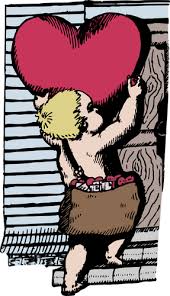
How did Eros evolve into the winged chubby baby shooting arrows of love on Valentine’s Day? Tales change and evolve over time. Roman culture adopted most of the Greek myths, and with that came Eros, who they renamed Cupid. The story slightly morphed into him following the wishes of his mother to make people fall in love in a not-so sinister way. He went from being a young, handsome, and mischievous god to being a winged baby. He still had his bow and arrow, but as an infant, he no longer appeared to be a threat. Paintings and stories no longer depicted him as sinister. “Representing Eros as a child, and subordinate to his mother, is a way of containing or limiting the power that love was thought to have over us,” says Catherine Connors, PhD, a classics professor at the University of Washington.”
Cupid, meet Valentine’s Day
By the start of the 19th century, Cupid and Valentine’s Day were heavily involved in their own love story that’s still going strong today. Greeting card manufacturers started the trend by linking the two together. The first Hallmark produced Valentine’s Day card appeared on store shelves in 1916. Soon after that, the boom of Cupid and Valentine’s Day went into full forced merchandising. Today, you’ll find cards, clothing, flower bouquets with little Cupids attached, stickers, candy, and just about anything you can think of with Cupid attached to it. From a devious god to a mascot for the holiday of love, two things remained consistent for a couple thousand years: Cupid is still depicted with his bow and arrow, and he’s still out there helping people fall in love; not forcing them, but helping them.
One last note about Cupid that you may find interesting if you’re a fan of Disney’s Beauty and the Beast. Not only was Eros/Cupid out there spreading love for centuries, but he had his own love story to boot. The story of Cupid and Psyche is the inspiration for the Disney story, Beauty and the Beast. “Cupid’s mother, Venus (Aphrodite), became so jealous of the beautiful mortal Psyche that she told her son to induce Psyche to fall in love with a monster. Instead, Cupid became so enamored with Psyche that he married her—with the condition that she could never see his face. Eventually, Psyche’s curiosity got the better of her and she stole a glance, causing Cupid to flee in anger. After roaming the known world in search of her lover, Psyche was eventually reunited with Cupid and granted the gift of immortality.” As it goes with these types of love stories, they lived happily ever after.
I can honestly say I’ve never been a fan of Valentine’s Day. Halloween and Christmas are my favorites, but in the spirit of love, and my interest in Cupid’s origin story, I’m glad I chose him for this week’s topic. His past is tainted with darkness and devious games, but in the end he is a symbol of love and even found true love. Cupid’s story is in itself a love story and that is truly beautiful.


 jonsolosebastian.org