Jon Solo Sebastian 11/21/2025:
This one is a little behind schedule. I wanted to do this in October, so it would go along with all of my other Halloween-themed blogs for the month, but time was not on my side. Okay, I’m about to sidetrack before I even get started, but “Time is on My Side” is a song by the Rolling Stones, and a song that is sung throughout a film from 1998 titled: Fallen. It stars Denzel Washington, John Goodman, and Donald Sutherland. It’s a solid film that deserves a much better rating than Rotten Tomatoes has given it—but that could be said about a lot of films on there. Anyway, this has nothing to do with the Headless Horseman, but my sentence reminded me of that film, and I highly recommend watching it if you never have, and if you’re into supernatural thrillers, you’ll enjoy this one!
Back to our regular programming….

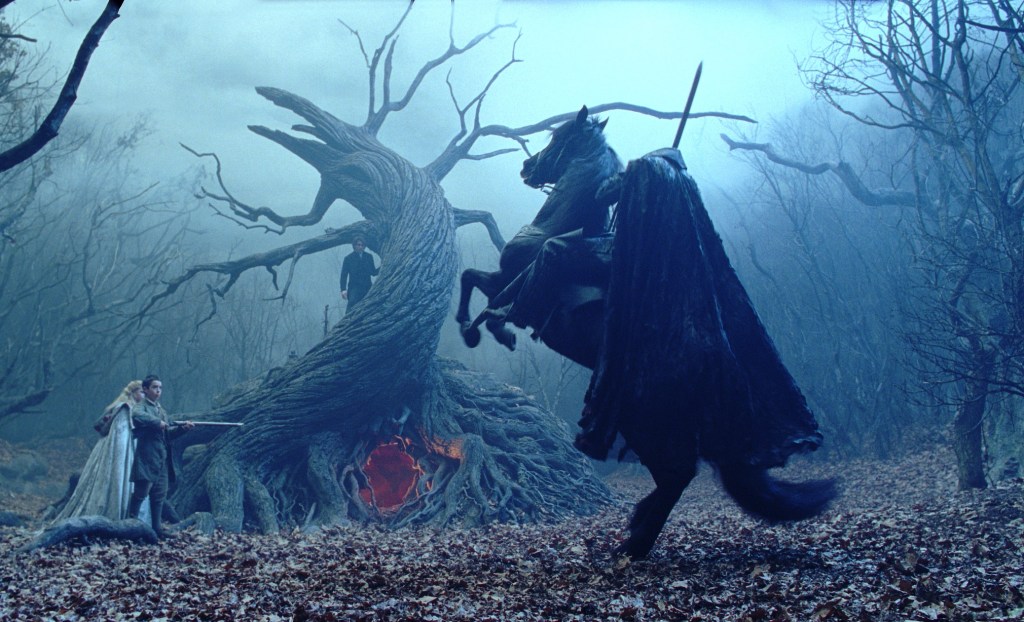
The Headless Horseman is a classic story from American folklore that some consider to be one of America’s first ghost stories. While tales of headless horsemen have been told since the Middle Ages, the legend became popularized by a short story titled: The Legend of Sleepy Hollow, which was written by Washington Irving in 1819 as part of his short story collection. For the most part, the tale doesn’t give a lot of details about the headless horseman, as it focuses more on Ichabod Crane and his courting of Duchess Katrina Van Tassel. That said, there is speculation of who the headless horseman is—if he were real.
A quick comment about the author, Washington Irving, he to some extent matches what I’ve been doing with my short story series titled: The Hunted, which you can find on Amazon, Barnes and Noble, Apple, and other platforms. He weaves factual locations into his supernatural story. In my books, I use fictional names for the locations, but they’re all locations that readers from my hometown should be able to identify. This isn’t something new—even when Irving did it back then, but it gives the fictional story hints of realism, and with any luck, it could bring tourists to town, which is something that has been happening in Sleepy Hollow for a long time. Locations like: Old Dutch Church and churchyard, Major Andre’s Tree, along with family names such as Crane and Van Tassel were used in Irving’s story.
On that note, according to The New York Times, there was a real Ichabod Crane, who Irving got the name from… likely, without permission to use the name. “The real Ichabod Crane was born in 1787. He was not bony or awkward; Crane was a long-time marine and soldier. He first enlisted in 1809, and The American Primer reports that he went on to have a 48-year career in the military. The History Reader states that Crane was a captain in the War of 1812. Moreover, he was also involved in the Black Hawk War in 1832, the Second Seminole War in 1835, and the Patriot War in 1838. By 1843, he had been promoted to colonel and served in the Mexican-American War. Crane died in 1857 at his Staten Island home.”
Who is the Headless Horseman and what does he want?

While we’re leaning on the side of there not actually being a headless horseman roaming the area of Sleepy Hollow, there could be some ties to the real world here. A man who fits the bill could be a fallen soldier from the Battle of White Plains. It is believed that a Hessian soldier was decapitated by a cannon ball at the beginning of the battle that started right around Halloween of 1776. His soul is then unable to rest until he finds his lost head. So he is eternally doomed to ride throughout the night looking for it, and scaring everyone in town in the process.
Other depictions of the headless horseman outside of Sleepy Hollow, include stories from the Brothers Grimm, and the Dullaghan of Irish legend. The Dullaghan is a headless horseman of Irish folklore. Like his cousin in America, he rides through the night on a black horse, but this version carries his head with him. He holds his head high as he rides, and “the mouth of his head is always in a hideous grin that touches both sides of his head. The eyes of the head constantly move so that he can see across the countryside even when it is at its darkest. The head itself is the color of moldy cheese. As a horsewhip, the Dullaghan used the spine of a human corpse and the wagon that he pulled along would be adorned with funeral objects.” If the Dullaghan stopped riding for a moment, that would signify impending death upon someone in the town. He was in a sense, a grim reaper, or similar to the banshees who weep when someone dies or is about to.

Every year around Halloween, folks travel over to Sleepy Hollow in hopes to see the headless horseman. Hikers traverse the woods and explore the cemetery. Folks claim to feel a presence, or say they feel like they’re being watched. Is it possible? Yes. The thing is, when you go to a place rooted in supernatural folktales, your mind tends to manifest things to make you believe a light breeze is actually a spectral creature whispering in the dark forest, or it could make you think branches knocking together sound like horse hooves marching toward you. Some say they’ve seen the headless horseman, and I want to believe them, but I really need to make the trip to see for myself. Have you seen him?


 jonsolosebastian.org