
An early depiction of the bloodsucking beast
I remember when I first started hearing about the Chupacabra. It was fascinating. I’ve always had a thing for vampires, so when Chupacabra’s popped up and were said to drain their victims, (mostly livestock) of blood, I became interested. Of course these made up creatures are nothing like vampires. There might be something draining blood from livestock around the world, but they’re not lizard-kangaroos or dog-like creatures.
Here’s where part of the problem lies—the descriptions originate from a creature not dissimilar to what was seen in a 1995 film called Species. Over time, they’ve been described to have more features like a dog or coyote. To paint a better word picture than lizard-kangaroo—a stance like a short kangaroo, gray skin, mangled hair or fur, a head similar to the gray aliens accused of abductions, black or red eyes, large fangs, a slit for a mouth, webbed bat-like arms, and large claws. The descriptions go from that, to what has been said to look like a dog with mange.
If the Chupacabra existed, the descriptions of its appearance wouldn’t be that far apart—even from opposite sides of the globe, they’d still carry similar characteristics. It would be like describing the Sasquatch as it’s typically described—taller than average man, covered in long brown hair, bipedal ape-like creature to also being described as a hairy lizard with an ape-like face with wings. Bigfoot or Sasquatch descriptions remain fairly consistent; especially compared to the Chupacabra. That said, their origin story, and the media craze is exciting.
The First Chupacabra Sighting
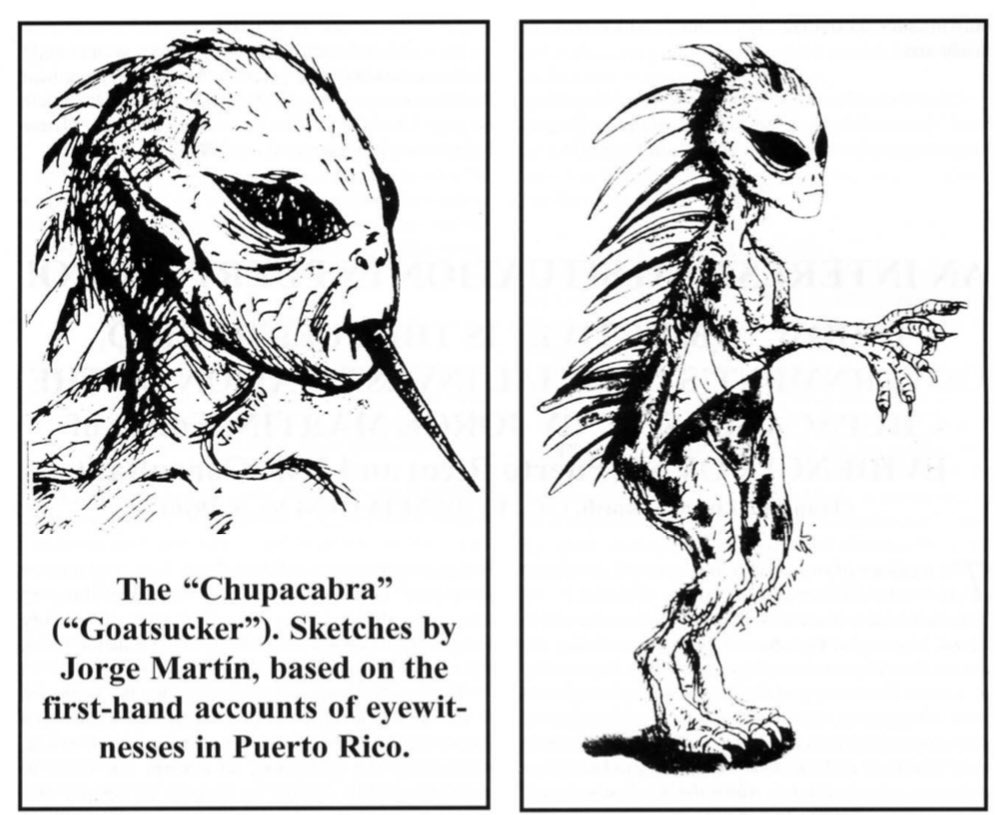
What fueled the Chupacabra craze that started in Puerto Rico? According to the Britannica, skeptics pointed to the film, Species that released that same year (1995). A lizard-like creature in the movie, with the original eye witness describing something similar after admittedly seeing the movie. Our eyes are little magicians that play tricks on us driven by our imaginations and fears. Similar to reports of dead cows that were related to alien abductions or operations, no clues were left behind—other than a lot of dead livestock.
Conflicting Descriptions and Reports
Sightings in other parts of the world began popping up soon after the original sighting. Dead livestock, puncture wounds, no blood, but this time instead of the lizard kangaroo, it was a hairless dog with a protruding spinal cord. A wildlife specialist determines that the dog variation of the Chupacabra is a coyote with a very advanced stage of mange. “What looks like a terrifying beast of legend is actually a pretty sad sight to see,” John said. “Most of the time when folks report a Chupacabra, it’s actually a coyote with very advanced stage mange.”
They’ve lost most of their hair other than near the back of their necks, the skin appears scaly, and they’re skinny due to being unable to hunt and eat. This leads to the punctures in dead livestock. Goats and sheep are easier for a coyote in this condition to “hunt” than rabbits because they don’t have the energy to try to catch them. They go after the easier prey. The problem here that puts some favor in confirming the Chupacabra’s existence is that the dead livestock aren’t eaten. What would be the point of the coyote biting into a goat and not eating part of it, and where is the blood going? I found a convincing explanation that states—“Disease and infection can kill seemingly healthy animals, and some insects drink blood from fresh corpses. When animals die, gases in their bodies can expand, splitting them open with seemingly surgical precision.” With the corpse’s bodies split open, blood could leak into the ground, which would then make them appear to have been drained.
There were similar stories dating back to the early 1900’s. The one consistent report in these sightings is goats being drained of blood. The possibilities are endless of what it could be that’s sucking the goats blood, and it mostly points to the strange and unexplained. Aside from the Chupacabra, there is the Vampire of Moca that left livestock drained of blood. Aliens reportedly do research on livestock and leave them dry of blood. It’s possible that this creature lives in the same dimension as the Sasquatch, and that’s why we never fully see it committing its late night crime of gruesome snacking. If you want to go down the road of dimension hopping with me—I’ll be traveling there in the near future.
During my research, I’ve learned the sightings of the Chupacabra have dwindled down over the years. I found a recent sighting from July of 2023 that took place in Bolivia. What’s cool about this one is there’s drone footage of an alleged Chupacabra in a field. The unfortunate thing is it’s not unlike the footage we often see of alleged alien craft in our skies—the video looks grainy and blurry, like it was filmed using one of the first cell phones with a camera. The shadowy bull-legged figure in the video certainly has the same type of stature as the Chupacabra, or perhaps it’s Gru from Despicable Me. The drone was apparently unable to circle towards the front of the “creature,” so it’s hard to say what it is. My question is—why did the drone or video stop there? Was it due to the range of the drone, or was that done intentionally because this is a hoax? There’s no denying the dead livestock, but what did it? Could it have been some other animal or creature? With our technology today, I believe we could have seen a much better quality video. This sort of thing was acceptable back in the 80’s and 90’s due to lower tech cameras, but now, it feels fishy to me.
The most important thing is this—something is killing livestock, and no one can prove what’s doing it. There’s something out there, and I hope we find some answers.


 jonsolosebastian.org
2 responses to “El Chupacabra”
[…] It’s a large animal, it’s able to stand on its hind legs, and if you remember my piece on the Chupacabra, the effects of mange changes the appearance of animals in a drastic and unpleasant way that could […]
LikeLike
[…] a large cat with horns on its head and glowing eyes. Some have described it as being similar to the Chupacabra but a cat version of it. Most descriptions are shrugged off as it being a mountain […]
LikeLike